The developer’s utility notebook
Better questions before the first bid.
Practical discussion guides for owners, developers, and their design teams.
01 / Early utility due diligence
A line shown near a parcel is a starting point for a conversation, not confirmation that the development can connect. Before comparing construction budgets, ask your civil engineer and the relevant utility owner to identify the proposed connection points, available service information, and unresolved approvals.
Collect the current survey, preliminary utility layout, available records, and known easement or access constraints. Keep a short open-questions register: the question, who can answer it, the needed decision date, and the estimate assumption until it is resolved. Separate confirmed information from allowances so everyone understands the same budget.
Useful handoff: one current drawing set and an assumptions list. Discuss pre-construction planning.
02 / Site constraints and utility potholing
Existing utility crossings, narrow access, occupied properties, and restoration boundaries can affect how work is planned. Ask which conflicts are supported by records, which have been surveyed, and which need field investigation before the design or estimate is finalized.
Potholing is a coordination topic for the design team and qualified field personnel—not a substitute for excavation planning. OSHA’s excavation standard distinguishes estimated utility locations from exact locations established by safe and acceptable means as excavation approaches them. Read OSHA 1926.651(b). California excavators should also follow applicable state requirements and the relevant notification center’s procedures; USA North 811 provides regional guidance.
For an estimate, flag known conflicts and unresolved investigation scope. Share your site questions.
03 / What to send for a useful utility estimate
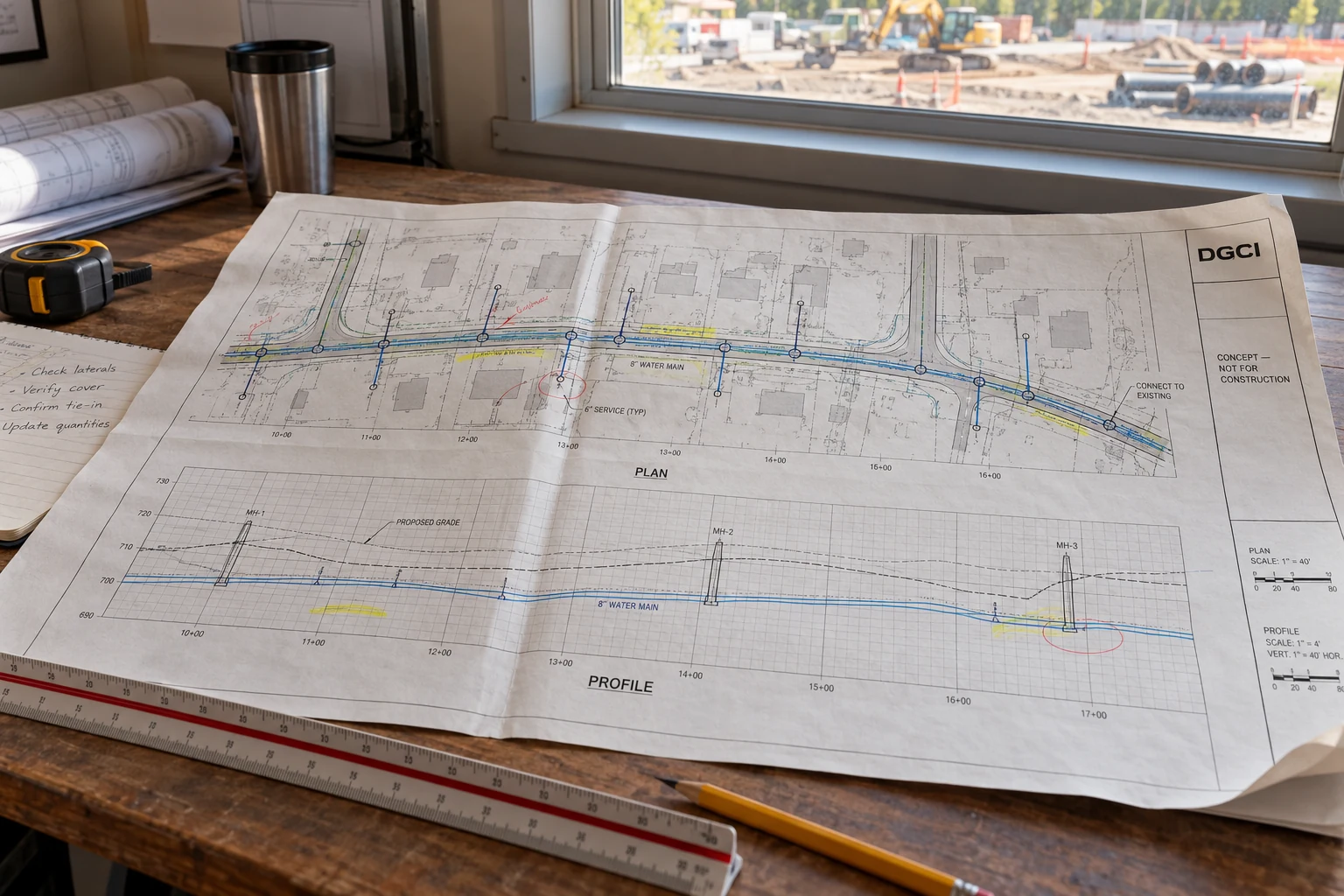
Make the bid invitation easy to understand: project name and city, your company and contact, the requested utility systems, bid deadline, desired start window, and a link to the current plan room. Include civil plan-and-profile sheets, specifications, addenda, and the available geotechnical and utility information relevant to the scope.
Label the drawing revision and identify the work included in other trades. Describe whether you need an early budget or pricing against a defined design. If something is missing, name it instead of presenting an assumption as a confirmed condition. Early budgets and detailed bids answer different questions.
Only share documents you are authorized to provide. Send your estimate request.
04 / Compare scope, not just the bottom number
Two utility proposals can cover different work. Put their inclusions, exclusions, quantities, and assumptions side by side. Ask about connection limits, excavation and backfill, disposal, imported materials, surface restoration, testing, inspections, traffic coordination, and responsibility for permits or fees where applicable.
Record unresolved items before selecting a proposal. For each one, identify the decision owner and how a revised quantity or changed condition will be discussed and documented under the contract. A clear comparison helps your team identify scope gaps; it cannot eliminate every unknown site condition.
Use the same scope summary for all bidders. Review DGCI’s utility services.
05 / Coordinate utilities with the rest of the site
Start the schedule discussion with interfaces: grading access, utility-owner involvement, other trades, material availability, testing, inspections, connection windows, and restoration. Ask the design and construction teams which activities depend on each decision and which dates remain provisional.
A utility route that crosses another trade’s work deserves an explicit coordination item. Track the responsible party, required information, and release point for the next activity. Keep the look-ahead schedule tied to current drawings and approvals rather than treating a desired start date as a confirmed mobilization.
Share both your target dates and known constraints. Discuss your project schedule.